
How field data, biophysical modeling, and community input point to a financially viable, Article 6-ready reforestation pathway in Zambia’s Lusaka Province
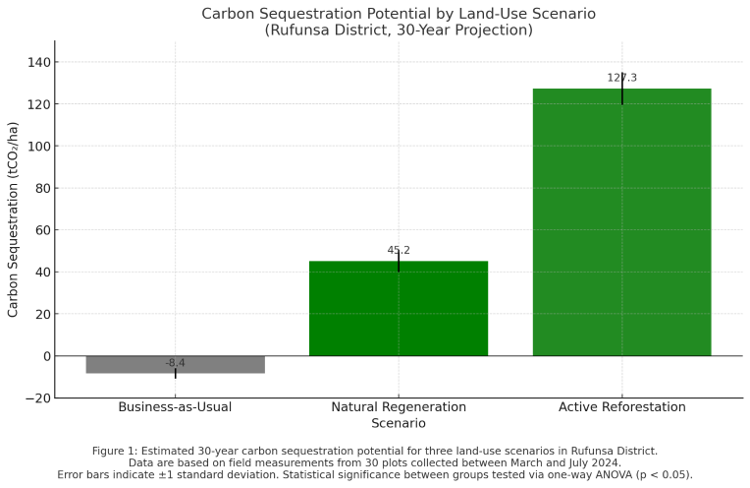
Active reforestation sequestered 127.3 ± 15.2 tCO₂/ha over 30 years nearly three times the 45.2 ± 8.3 tCO₂/ha achieved through natural regeneration alone, and a sharp reversal of the business-as-usual trajectory, which would instead emit the equivalent of 8.4 tCO₂/ha (185,000 tCO₂ district-wide) as deforestation continues. Of Rufunsa’s degraded land, 22,000 hectares were identified as suitable for reforestation, with the wettest zones (800–1,200mm annual rainfall) showing 40% higher sequestration potential than drier areas
Zambia’s Miombo woodlands cover about 40% of the country and support more than 60% of rural households, yet the country loses 250,000–300,000 hectares of forest every year. Rufunsa District, 120 km southeast of Lusaka, is losing forest at 3.33% annually a pace that would clear its remaining 40,126 hectares of intact woodland within a generation. Outdated carbon baselines, weak MRV systems, and undefined benefit-sharing arrangements have kept this landscape largely outside the reach of carbon finance, despite growing evidence that Miombo woodlands store far more carbon than legacy models assume.
This study set out to answer a practical question for investors, communities, and policymakers alike: is reforestation in Rufunsa District scientifically credible and financially viable under Article 6 of the Paris Agreement and if so, on what terms? The research combined two biophysical models InVEST for spatial above-ground carbon storage and CENTURY for long-term soil carbon and nutrient cycling calibrated against field biomass data from 30 plots across the district. Three land-use scenarios were compared over a 30-year horizon: business-as-usual (continued deforestation), natural regeneration, and active reforestation. Economic feasibility was tested through Marginal Abatement Cost (MAC) curves and Net Present Value (NPV) analysis across a range of carbon prices, and a household survey of 150 families across four wards captured community appetite for participation and concerns about benefit-sharing
Carbon sequestration potential
Financial viability
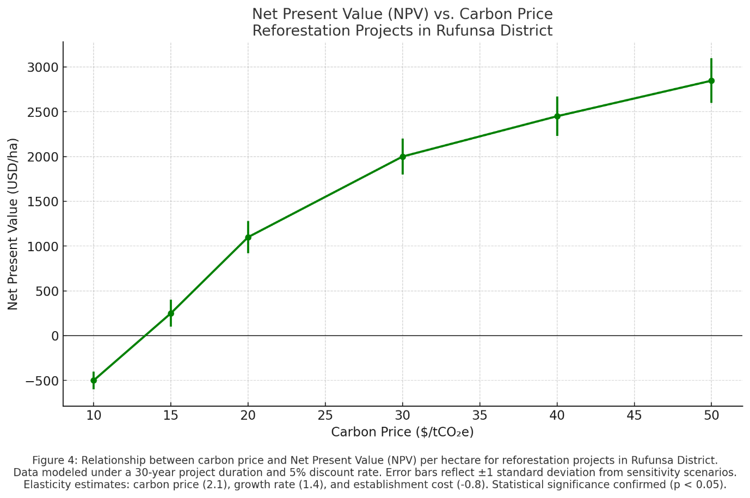
Reforestation becomes financially viable once carbon prices clear roughly $15/tCO₂e. At $10/tCO₂e, projects run at a loss (NPV of –$500 ± 75/ha); at $50/tCO₂e, NPV climbs to $2,847 ± 420/ha. Returns are most sensitive to carbon price movements, followed by establishment costs and tree growth rates — meaning market access and cost discipline, not biology, are the swing factors for profitability.
Cost-effectiveness across strategies
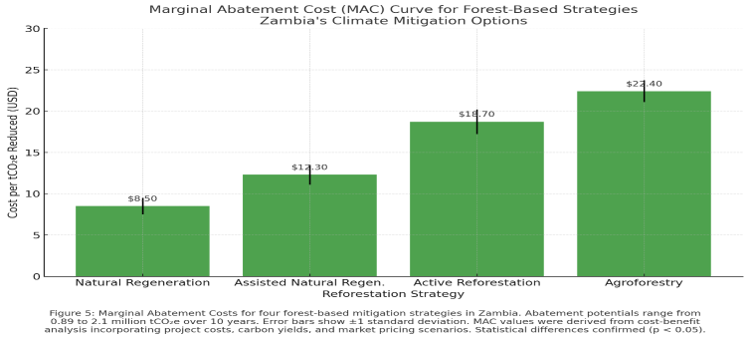
A Marginal Abatement Cost comparison ranked four restoration strategies: natural regeneration ($8.50/tCO₂e) is the cheapest, followed by assisted natural regeneration ($12.30), active reforestation ($18.70), and agroforestry ($22.40). All four undercut Zambia’s conventional NDC mitigation options — energy efficiency ($45/tCO₂e) and renewables (above $80/tCO₂e) — reinforcing forest-based mitigation as the most cost-effective lever currently available to the country.
Climate risk tempers, but doesn’t erase, the case
Roughly 30% of candidate reforestation land carries elevated drought risk and 18% elevated fire risk, which can cut sequestration yields by 15–30% and push MAC up by $2.80–$8.90/tCO₂e in the worst-case zones. Even so, risk-adjusted modeling shows reforestation remains economically viable across every scenario tested once carbon prices exceed $28/tCO₂e — a conservative threshold for investment planning.
Community appetite with conditions
Household surveys found strong grassroots support: 78% of respondents were willing to participate in carbon projects, 65% saw carbon payments as a route to income stability, and 89% wanted training in sustainable forest management. But 43% raised concerns about fair benefit distribution a signal that governance, not enthusiasm, is the binding constraint. That finding shaped a proposed three-tier benefit-sharing model: 40% of carbon revenue as direct participation payments, 35% into a community development fund, and 25% into capacity building and technical support, with quarterly stakeholder reviews to keep distribution transparent.
Why It Matters Beyond Rufunsa
Scaled nationally across Zambia’s 15 million hectares of degraded Miombo woodland, this model could deliver 25–40% of the country’s NDC mitigation target — 3.2–5.1 GtCO₂e over 30 years — while generating $480–800 million a year in carbon revenue and supporting 150,000–250,000 rural households. The Miombo ecoregion spans 2.7 million km² across southern and eastern Africa, so a validated, replicable methodology for this landscape has relevance well beyond Zambia’s borders.
Recommendations
- Standardize MRV protocols and develop regionally calibrated allometric equations for Miombo carbon accounting.
- Establish a national carbon registry and integrate Article 6 mechanisms into climate policy.
- Formalize transparent, community-anchored benefit-sharing frameworks and strengthen land tenure security.
- Blend carbon revenue with development finance, insurance for non-permanence risk, and micro-finance for community enterprises.
- Prioritize high-deforestation areas first and build multi-stakeholder governance platforms for adaptive management.
Rufunsa District’s Miombo woodlands are a credible, bankable case for Article 6 carbon finance — capable of generating up to $140 million in verified emission reductions while creating income and training opportunities for some of Zambia’s poorest rural households. Realizing that potential now depends less on the science, which this study strengthens considerably, and more on building the MRV infrastructure and benefit-sharing governance that communities have already signaled they need to see.
References
- Chidumayo, E. N. (2002). Changes in miombo woodland structure under different land tenure and use systems in central Zambia. Journal of Biogeography, 29(12), 1619-1626.
- Demol, M., Verbeeck, H., Gielen, B., Armston, J., Bowers, S., Calders, K., … & Verstraeten, W. W. (2024). Estimating forest above-ground biomass with terrestrial laser scanning: Current status and future directions. Methods in Ecology and Evolution, 15(1), 91-112.
- Frost, P. (1996). The ecology of miombo woodlands. In The Miombo in Transition: Woodlands and Welfare in Africa (pp. 11-57). Center for International Forestry Research.
- IPCC. (2023). Climate Change 2023: Synthesis Report. Contribution of Working Groups I, II and III to the Sixth Assessment Report of the Intergovernmental Panel on Climate Change. Geneva: IPCC.
- Republic of Zambia. (2020). Updated Nationally Determined Contribution. Ministry of Green Economy and Environment.
- UNFCCC. (2021). Article 6 of the Paris Agreement. United Nations Framework Convention on Climate Change.
- United Nations Framework Convention on Climate Change. (2021). Article 6 of the Paris Agreement: Rules, modalities and procedures for the mechanism established by Article 6, paragraph 4, of the Paris Agreement. Decision 3/CMA.3. Available at: https://unfccc.int/documents/460950
- Republic of Zambia. (2020). Zambia’s updated Nationally Determined Contribution (NDC) to the United Nations Framework Convention on Climate Change. Ministry of Green Economy and Environment. Available at: https://www4.unfccc.int/sites/ndcstaging/PublishedDocuments/Zambia%20First/Final%20Zambia_Updated%20NDC_2021.pdf
Source: Mbambi, Blutus ,GGGI. “Modeling Emissions Reductions and Financial Viability of Reforestation in Rufunsa District’s Miombo Woodlands through Article 6 Carbon Markets.” Full technical paper available on request